How to start a coffee shop in the Philippines
Decide when to commit to a Philippine café: test orders needed to cover costs, check location and registration evidence, and use lease-to-opening decision gates.

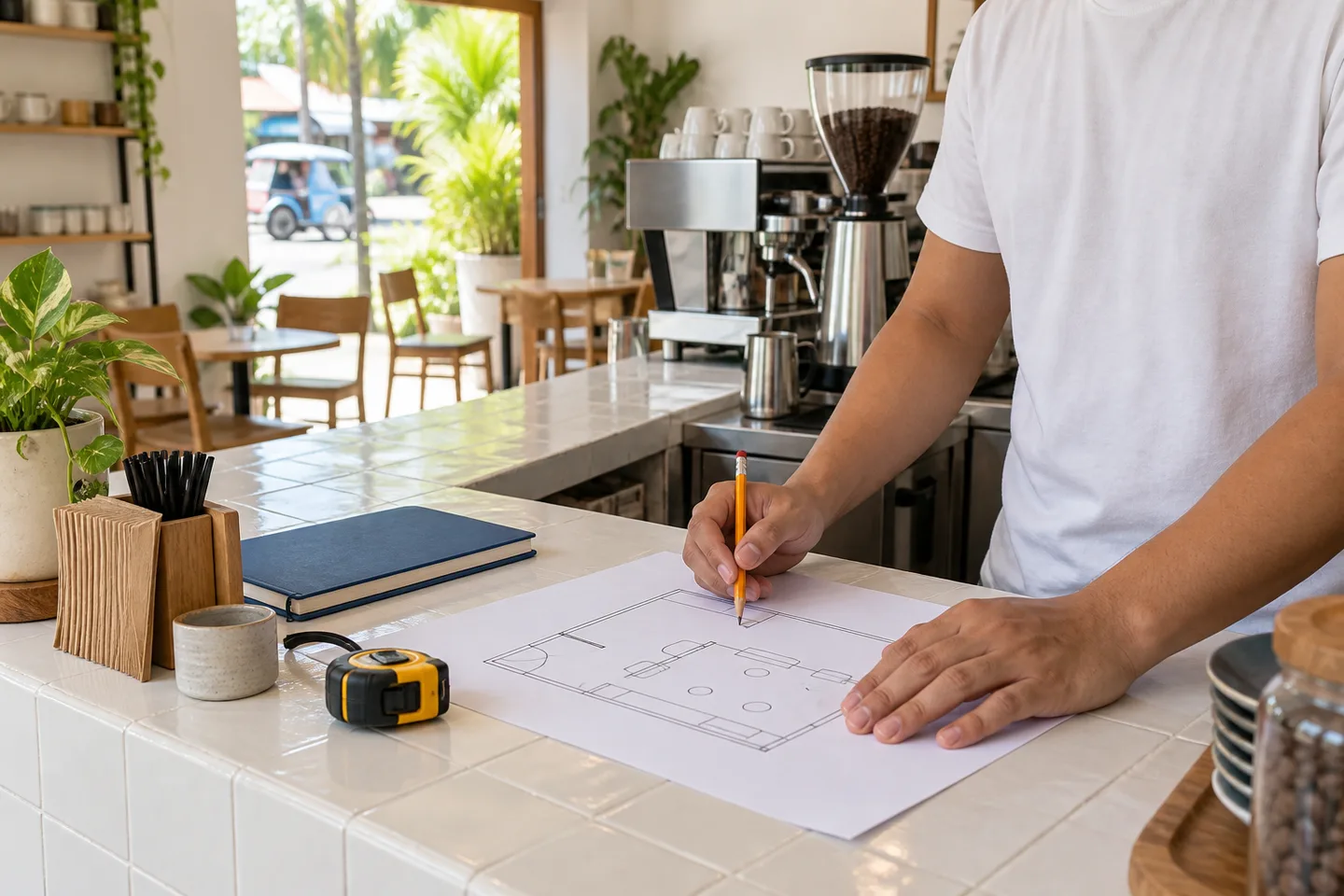
To start a coffee shop in the Philippines, define your customers and menu, obtain quotes for your proposed location, and confirm the registration and premises requirements that apply to your business structure and LGU (local government unit). Then rehearse the working day: taking orders, preparing drinks, recording peso payments, and closing the counter.
You do not need to settle every detail immediately. You do need to identify which assumptions are still untested before you commit to a lease, equipment, or a large opening stock order.
Use the orders-to-cover-costs example to challenge the economics, then the commitment gates to decide what evidence you need next. Both are planning aids with hypothetical inputs, not forecasts of Philippine café earnings.
Describe the café in one useful sentence
“A neighborhood takeaway counter for people walking to work” is more useful for planning than “a café for everyone.” It suggests a service window, menu, layout, and pace.
Write down your intended customer, the reason they would visit, and the time of day you expect to serve them. Observe the area at those times. Note foot traffic, nearby workplaces, access, and the alternatives a customer already has.
Treat these observations as inputs to test. A busy street does not automatically mean people will stop, and interest from friends does not establish everyday demand.
Test a small menu before expanding it
Start with a focused set of drinks and food that fit your concept. For each item, document the recipe, serving size, preparation steps, and ingredients.
Make the same drink several times with the person who will prepare it. Check consistency and how long it takes to complete an order. Ask for specific feedback about taste, portion, and the ordering experience.
Look at the ingredients behind the menu
A new menu item may add more than a recipe. It can introduce another supplier, a perishable ingredient, extra storage, and a new cleaning task.
Create a simple ingredient list across the menu. Shared ingredients can simplify receiving and preparation, but avoid making every drink depend on a single hard-to-source item. Use the ingredient-use worksheet to connect drink recipes, stock counts, and recorded waste.
Build a cost plan from actual quotes
List the one-time costs of getting the space ready and the recurring costs of operating it. Request quotes that match your intended equipment and location instead of treating someone else’s café budget as a reliable estimate.
Build the worksheet in Philippine pesos and note whether each quote includes applicable taxes, delivery, and installation. Obtain equipment servicing and ingredient-delivery terms for the city or municipality where you will operate. A Metro Manila supplier’s advertised price does not tell you the delivered cost or service availability for a café in another province. Keep unconfirmed charges visible instead of publishing a single nationwide “cost to open a café.”
Your working list may include:
- Lease deposits, fit-out work, and utilities setup.
- Brewing equipment, water treatment, refrigeration, and small tools.
- Ingredients, takeaway packaging, and cleaning supplies.
- Staffing, training, maintenance, and recurring services.
- Registration and permit costs that apply to your setup.
- Cash needed to cover operating expenses while the business develops.
Record what is confirmed, what is estimated, and what is still missing. Test the plan against quieter trading days and equipment downtime, as well as the sales you hope to achieve. Have an accountant review the assumptions before making major commitments.
For staffing, start with the NWPC’s current regional wage references and confirm the applicable region, establishment category, wage order, effective dates, and advisories. Build a full staffing budget with your accountant, including applicable benefits, employer contributions, and the hours you plan to operate. A daily wage figure alone is not the monthly cost of staffing a café. This guide does not assume an NCR rate applies elsewhere.
Before opening, decide who prepares payroll, reviews the figures, and keeps the pay records. Compare actual peso payroll costs with your staffing budget each pay period and investigate differences. Sentra offers payroll on selected plans; if you are considering it, ask for a demonstration using your café’s pay setup and review the results with your accountant.
Work backward from costs to required orders
Contribution per order is average sales revenue per order minus the costs that vary with that order. It is the amount available to cover recurring fixed costs before any remainder. Include ingredients, packaging, expected wastage, and applicable per-order payment or platform charges in variable costs. Use sales after discounts; ask your accountant which taxes belong outside revenue and which costs your business bears so both sides use a consistent basis.
For a menu with several products, use a realistic sales mix: total expected revenue minus total variable costs, divided by expected orders. An order may contain several drinks or food items. Do not divide an average basket’s revenue by a single drink’s ingredient cost. Cost a delivery-platform order separately if its contribution differs from a walk-in order.
For this hypothetical operating model, suppose average sales revenue is ₱150 per order and variable costs are ₱60. Contribution is ₱150 − ₱60 = ₱90 per order. Suppose monthly fixed operating costs are ₱144,000 and the café trades 26 days a month. These are invented planning inputs, not price, wage, or rent benchmarks.
Orders needed per month = fixed operating costs ÷ contribution per order = ₱144,000 ÷ ₱90 = 1,600 orders.
Average orders needed per trading day = 1,600 ÷ 26 = 61.54, or about 62 orders when planning whole orders. If contribution is zero or negative, increasing volume cannot cover fixed costs under this model; revise the price, cost, or menu first.
| Hypothetical demand | Monthly orders at 26 days | Contribution at ₱90/order | Result after ₱144,000 fixed costs |
|---|---|---|---|
| 45 orders/day | 1,170 | ₱105,300 | −₱38,700 |
| 62 orders/day | 1,612 | ₱145,080 | ₱1,080 |
| 80 orders/day | 2,080 | ₱187,200 | ₱43,200 |
This result is before income tax, financing, and recovery of startup spending. Include the staffing and owner-compensation cost you intend to pay in your assumptions; account separately for owner withdrawals. Crossing 62 orders does not repay the fit-out or prove that cash will be available when bills fall due.
Stress the contribution as well as demand. If average variable cost rises by ₱10 with the same ₱150 revenue, contribution falls to ₱80 and the daily requirement becomes ₱144,000 ÷ ₱80 ÷ 26, rounded up to 70 orders. Ask whether your observed customer demand and rehearsed peak-hour capacity can support that volume. An all-day average does not establish that a small counter can handle the morning queue.
Separate opening money from a slow-month reserve
Keep three amounts visible: cash spent before opening, deposits or other tied-up cash, and the operating reserve left afterward. Count a payment once. A refundable lease deposit may tie up opening cash without being a monthly operating expense; a financed machine creates payment dates beyond its initial down payment.
At the hypothetical 45-order level above, the operating shortfall is ₱38,700 a month. If ₱150,000 remains as a reserve after opening commitments, ₱150,000 ÷ ₱38,700 ≈ 3.9 months is a rough coverage estimate only if that monthly cash shortfall stays constant and there are no other outflows. It is not a recommended reserve. Map actual payment dates, stock purchases, tax obligations, debt payments, and settlement timing before treating it as cash runway.
Check the location’s practical constraints
A space can look right and still be difficult to operate. Before committing, check the water supply, drainage, electrical capacity, ventilation, storage, waste handling, and delivery access with the appropriate specialists.
Map the path of an order. A cashier, barista, and customer should not need the same small piece of counter space at the same time. Consider where dirty equipment returns, where clean cups are stored, and how a queue affects the entrance.
Confirm proposed work and permitted use with the landlord and the relevant local offices before signing or beginning renovations.
Confirm registration and local requirements
Requirements depend on the business structure, location, and activities. Start with the official agencies rather than treating a generic opening checklist as a complete approval process.
The DTI explains that business name registration provides a business identity and does not replace the business or mayor’s permit needed to operate. Contact the city or municipality’s business permits office about the proposed café and premises, and review the BIR’s registration requirements with your accountant or Revenue District Office.
Keep a record of the offices contacted, documents requested, and steps still outstanding. Confirm current requirements before setting a public opening date.
Keep an authority and evidence record
This planning map was checked September 12, 2026. It identifies questions to resolve with the responsible offices; it is not a complete permit list or legal advice for a particular entity or premises.
| Decision | Official starting point | Evidence to keep in your opening file |
|---|---|---|
| Sole proprietorship, partnership, or corporation? | DTI’s BNRS guidance above; SEC eSPARC covers partnerships and corporations, including OPCs. | Chosen entity, registration documents, and which person/entity will sign the lease and supplier contracts. |
| Can this café operate at this address with the planned work? | The city/municipality’s business permits office and the local offices it identifies. | Dated requirements for the address and activities; landlord consent; status of zoning, building, fire, sanitary, and food-handler checks as applicable. |
| How will the business register and issue invoices? | BIR registration guidance above, your RDO, and your accountant. | Registration status, books/invoicing arrangements, responsible person, and outstanding steps. |
| What does the proposed staffing schedule cost? | NWPC regional references above; confirm other employer obligations with the responsible agencies. | Wage-order scope and date, staffing hours, applicable benefits/contributions, and a reviewed payroll budget. |
For a Quezon City example only, the city’s business-opening guide, updated April 8, 2026, says a lease must include use as a place of business and that applications undergo zoning and other applicable departmental review. This shows why an attractive vacant unit is not enough evidence. Obtain your own LGU’s current requirements; the QC documents and process do not establish the rules for another municipality.
For every unresolved item, record the office, contact date, written answer or reference, next action, and person responsible. A submitted application is still an open item until the required outcome is confirmed. If the café will also manufacture packaged products, serve alcohol, or carry out other activities, describe them when requesting requirements.
Rehearse a complete shift
Test the workflow with a small group before a full opening. Run the tasks in order:
- Receive and store ingredients.
- Prepare the counter and check equipment.
- Take a mixed order with a modifier or substitution.
- Record payment and hand over the order.
- Correct a mistaken order.
- Count key ingredients and record waste.
- Close the register and clean the work areas.
Write short instructions where the team gets stuck. If you are selecting checkout software, use the POS trial scorecard to turn this rehearsal into a practical product trial.
Decide what to commit next
Use these gates to pause spending when a critical assumption remains open. “Proceed” means the evidence supports the next commitment, not that the café’s success is assured.
| Before committing to… | Evidence needed | Pause or revise when… |
|---|---|---|
| A lease | Location-specific requirements, feasible utilities/work, delivered-cost quotes, and a demand/cost scenario for this site. | Permitted use or essential work is unresolved, or required orders exceed supportable demand/capacity. |
| Equipment and fit-out | Tested menu, measured layout and utility requirements, supplier service terms, and a dated cash plan. | The chosen equipment does not fit the premises/menu or consumes money needed for opening and operating commitments. |
| A public opening date and opening stock | Applicable approvals confirmed, team rehearsal completed, ingredients available, and cash/payment records that can be reconciled. | Required approvals remain pending or the team cannot repeat the order-to-close routine. |
Write the next decision as a short note: commitment; maximum amount at risk; evidence still missing; owner; decision date; condition to proceed. For example, “Obtain the electrical assessment and revised installation quote before ordering the espresso machine” is a useful next action. A longer shopping list would not resolve that uncertainty.
Use opening week to learn
Keep a daily note of what sold, which orders caused delays, and what customers asked for that the menu did not explain. Review the notes with the team before adding more products or changing several processes at once.
A useful first milestone is a shift the team can repeat confidently. Build from that foundation with clear records and small, deliberate improvements.
Practical knowledge. A clearer next step.
More from Sentra Insights